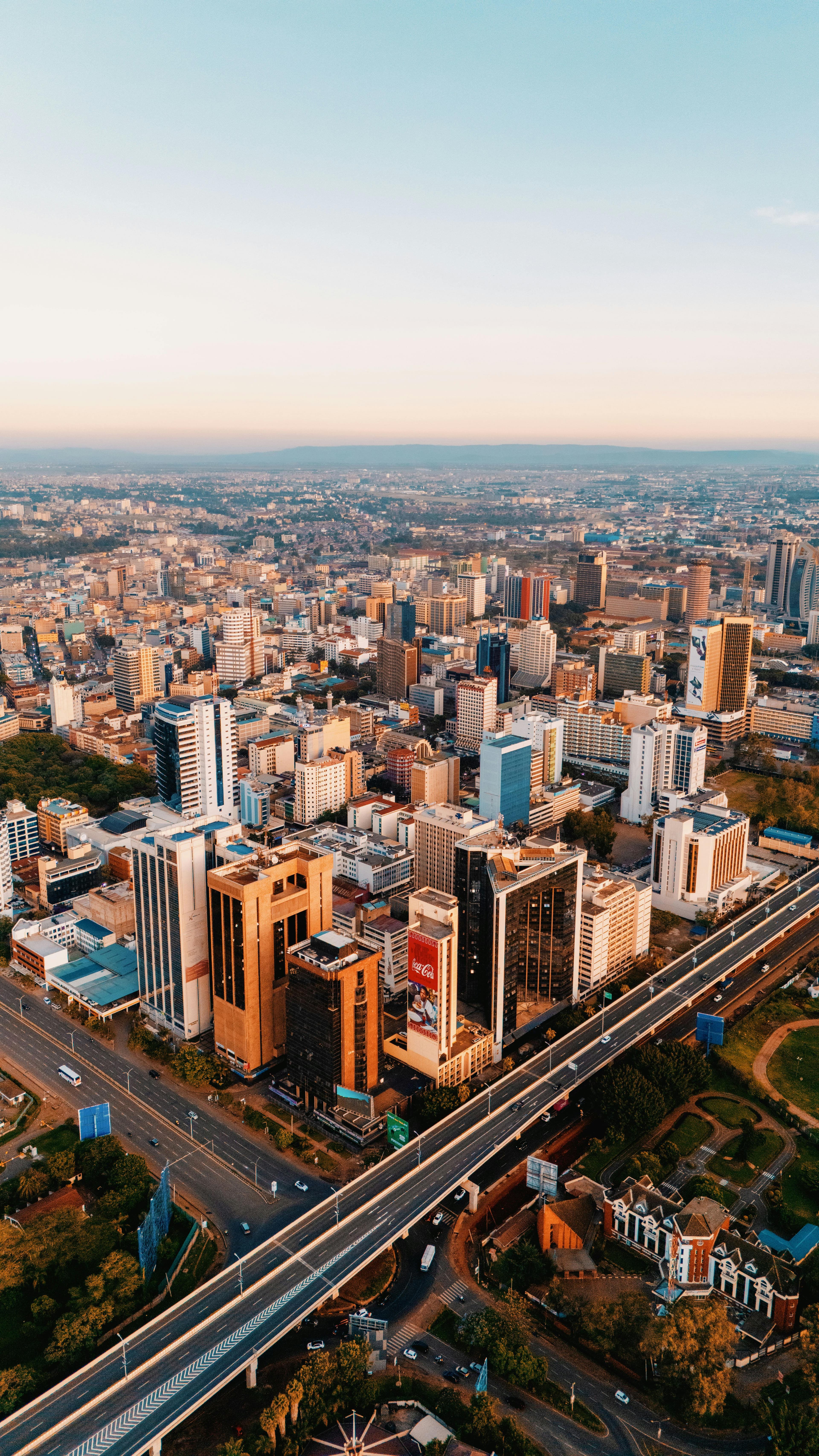
Nairratives Gone Bad by Otieno Arudo

The Editors
Contributor
Published in Qwani 04
-
I know you've read a bunch of articles that describe Nairobi in a certain way. It's normally a poetic piece that tries to tell you how Nairobi is a city of contrast: of beauty existing alongside capitalistic cruelty, how Nairobi is economically hard—'shamba la mawe'—but also vibrant with hope, etc. The essay that describes Nairobi is a narrative that has specific tropes, which we know at this point. But Nairobi was not always a tropical city (that is the quality of being associated with numerous tropes).I will tell you about the tropes and how they perpetuate harmful stereotypes and reinforce unfair power dynamics, like the responsible media theorist I am. But first, I must paint you the picture of what Nairobi was before its otherwise Pangean identity split into a Laurasian Gen Z and the Gondwanian Goon Z.
The politically correct thing to say is that urban poverty results from structural issues exacerbated by policy decisions taken up by short-term political actors. But this piece is not about being politically correct, and if you thought so, well, tough luck; here we say things as they are. The truth, let me tell you, "Ni mimi nakushow" as we say, is a long time ago, the young people of Nairobi used to be the same. Carbon dating of receipts from KFC Westlands place the Gen Z golden age at circa 2019 where they all ate the same food at KFC and used the same Ubers and cool nganyas. But then one day,they decided that they wanted a better diet and better cars, so they decided to go visit parliament where there is better food and transport. Young Nairobians are not libertarians like me. They believe that the state can run things efficiently: CDF is more nutritious than KFC. And the fact that a state-given car is better than a private one does not seem to contradict the much-castigated neo-liberal gospel of personal financial independence. What a coincidence! But I hate the pretense of wanting the government out of their pockets but into their bellies.
But the young people, learning from the African fable of the tortoise who accompanied the birds to a heavenly feast and took the name "everyone," eating all the food and leaving none for them, decided they will all go by the name 'Gen Z'. "We are all Gen Z." But my story is not a fable; it is a true one, and therefore, unlike in fables where people are invited for feasts, the Gen Z found themselves not invited at all. They were chased away.
But you see, after being chased away and having declared themselves communists who prefer government things, the private KFC where they all used to eat decided to teach them a lesson, revising the prices of food like the pasua, which now sold for seven times the street price. A crisis meeting was held at a place called X. How many days and nights the Gen Z debated about what to do next! Opinions were many, resulting in disagreements that were bitter. Some advocated that they be sent as emissaries to go back and sweet talk the parliament people so that they can be let into the feast, but in the end, they only gained entry for themselves. The remaining Gen Z could not decide whether KFC did a good thing or not. It is at this point that they split into two factions: Gen Z Asili and Goon Z. Ever since then, Nairobi has been divided into Gen Z and Goon Z neighborhoods.
This is the truth, a mystical story that the literalist "lame stream media" will not tell you because they'd rather stick to funder talking points like "systemic oppression," "generational poverty," and "increasing inequality." Before the great Gen Z vs. Goon Z split, Nairobi was a tranquil city under the sun, like a light upon the hill, a regional beacon beheld by many far and wide. It has since then turned into a caricature of itself, a collective construct of tropes that we debate from time to time without ever agreeing what the city really is or what it represents. I suppose the philosopher that said we can't know the "thing in itself" was right. But Nairobi is not lacking in philosophers; after all, it has several universities (one being world-class) with philosophical departments, and so it is not proper that we shy away from challenging the idea that we cannot know what the real Nairobi is. By using reason, the ultimate characteristic that separates man from beast, I will sift through the narrative tropes to deconstruct some of these outstanding lies that people just can’t seem to shake off.
The Green City Under the Sun Trope
There is the green trope. You’ve probably heard it — how Nairobi is the only capital city in the world with a national park within its boundaries. What critics fail to see, however, is that this is not just a park; it is a real time proof that the elusive urban-natural harmony can happen. Lion prides don’t just roam near Rongai for show, they remind us that nature and progress can co-exist, sometimes even in traffic. Scavenging hyenas and vultures, often misunderstood, are actually part of an integrated waste management strategy. Nature’s original cleaning crew, operating without pay, tenders, or SHIF deductions. If anything, the city’s environmental model should be studied by top universities — as long as they rank above the world-class one already in Nairobi. Much has been made of the Nairobi Declaration, with cynics calling it “just another document.” But this is a narrow view. The Nairobi Declaration is a bold statement — not just on paper, but in spirit and intent. It shows that Nairobi takes carbon markets seriously. So seriously, in fact, that we’ve opted for a market-based approach where citizens contribute organically: by walking when fuel is too expensive, or inhaling diesel as a form of voluntary carbon offset.
Now, a point of etiquette must be addressed. In Nairobi, we do not refer to wazungus as tourists. That would be crass. We say expatriates, because unlike tourists who come for leisure, our white visitors come for impact. They work remotely, drink kombucha, launch start-ups, and give TEDx talks on “community-centered innovation in post-colonial spaces.”. They consult, and while we have museums, forest trails, and historic buildings, it is important that we discourage too much tourism talk. Tourism is for other counties — coastal, pastoral, or otherwise scenic. Nairobi is too important economically to be reduced to a mere destination. Do you visit New York to look at trees? Do people fly to Tokyo to see birds? No. They go to transact. To connect. To pitch. That’s why the narrative of Nairobi as a “green capital that attracts tourists” is offensive. We are not a photo-op. We are a city of policy, potential, and public-private partnerships.
The Good Weather Trope
Closely related to the nature trope is the one about good weather which expatriates love, but some folk from neighboring countries find it too cold. This trope is normally accompanied by memes about how the coldness of Nairobi reflects the cold hearts of its occupants, people who cannot love properly but crave partners only to chase away the cold. Is that a contradiction?
Let not social media and radio shows lie to you. If you ever happen to find yourself in the CBD on any given Sunday afternoon, you will find lovers in droves, like locusts invading a shamba they invade the streets, walking like conjoined Siamese twins, smiling in a cheesy way as they block paths because they are taking photos. The loudness of their PDA is analogous to the loud flapping of the locust, and when they're gone they leave destruction for those who "wanajua kitu iliwaleta Nairobi."
Look, everyone has their teenage-hood sweetheart whom they have known forever; maybe it worked, maybe it didn't work, but that is life. But these Nairobi lovers, man, they'll make you feel like you never had your sweetheart. They will show you love like you do not know the meaning of the word. Social media posts will show you reels of dates at restaurants that you didn't even know existed with prices that you didn't even know existed. You scroll down on these posts with a resolve that you also must one day take someone you fancy to such a place. You are not a cynic; you know that love requires commitment and speaking the "love language" of your partner. Sometimes this language might be traveling, good foods, gift giving, among other things. I therefore take time to work on myself so that I am able to better master things like good communication and emotional availability for when I get into a fulfilling relationship. It is shallow to insinuate that romance has become transactional and even more preposterous to think that people are doing it for money and looks. All Nairobi girls are beautiful, so "looks" is not an issue. All a young gentleman needs is confidence and pure intentions while approaching. But these young men, they have been poisoned by the so-called "manosphere experts" and so they are beta with women for no reason. These are the people who go around peddling the narrative that Nairobi is not a place for love.
The women, on the other hand, are living their best lives. I have yet to come across a woman in Nairobi who does not have a lover. They are, after all, better communicators and emotionally available. In fact, the only woman I have seen on Twitter ascribe anything close to this was a statement, "Nairobi ni ya mandamano si ya mapenzi." That is understandable; some people forgo romance so that they may achieve greater goods, just like a nun would forgo romance and marriage in service of God. I am a man of logic, and I hate biases, and so even though I am single, you'll never hear me saying that Nairobi is not a place for love, because I know and accept my own personal shortcomings.
The Poor Drainage Narrative
There is a narrative about poor drainage. This one, I think, comes from disingenuous conspiracists who purport that Nairobi is derived from a Maasai phrase meaning 'a place of cool waters,' who are also the same people who keep insisting Nairobi is a swamp. Now, I respect linguists as much as the next man, which is why I fault them together with archeologists like Johnstone Kamau wa Ngegi for not challenging with academic rigor how a city can simultaneously be a swampy place and be called a place of cool waters? It is a travesty that this contradiction has been left unchallenged by academia for the decades the world-class University has existed in the city. I suspect this spin is from people whose towns have not been declared cities despite the fact that the current administration has no problem handing out the designation to any Town, District, or Hamlet.
Listen, if Nairobi (Shamba la Mawe) is a swamp, then the only thing that can be done is to drain it by initiatives such as planting Eucalyptus. But what does one make of Venice, one of the greatest cities to ever exist? Anyway, before a budget is made to procure trees that environmentalists don't like hugging as much, a comprehensive conclave with all societal players, including real Botany professors who are not mad, will need to sit down and decide what is best for the city. We all know Public Participation never works, that is why we must accept this conclave as the only way forward, otherwise the trees might be planted only for residents to have a change of heart in less than two years. Some people want the county government to build drainage systems. But I want them to consider the fact that money is tight and some fancy things are not a priority for the millions of residents who urgently need new cabro pavements and dustbins. The county government has been stellar in delivering this policy as part of the "Nairobi ina-Walk" manifesto it was elected on. Daily inspections of these pathwalks and bins by the ever proactive Mr. Moreserious, show that the county government is committed more than Leslie Knope of the Pawnee Park and Recreations Department. Otherwise, there are a few teething problems and "implementation challenges," but the roll out is going on well, and citizens should adopt it so that they are able to compete globally. The people who complain about drainage are also not mature and are holding our politics back. The other day we saw elections in New York where the different candidates practiced civil politics and were talking about big ideas like free transport coordinated throughout the city and affordable housing. Not once did you hear them discuss silly things like drainage systems. We really must improve the quality of political discourse, not only in this city but in the country as a whole.
The Nairoberry Trope
Then there’s the good old trope of Nairoberry (sigh). This is the gritty underbelly so dramatically painted in Meja Mwangi’s books and forever cemented into the global imagination by the monumental Nairobi Half-Life. But ever since then, every Kenyan film has just been a carbon copy with slight costume changes: a talented young man from the village — or sometimes a “raw diamond” from the slums — comes to Nairobi to “make it,” but alas, finds the grind too hard, the system too cruel, and inevitably ends up in crime. Sound familiar?
Nigerians have their voodoo. Bollywood has its slo-mo stunts and invisible wind machines. And Kenyans? We have the crime pivot. You could start your film on a football pitch, a gospel choir, or in a coding bootcamp but you already know where it's going. Somewhere, somehow, someone will pickpocket someone, and boom, character development via crime.These filmmakers "feel" — and I stress, feel — that crime is a big issue in Nairobi. But when was the last time any of them made a film based on a true headline? Not "inspired by" but actual reported news? Why not make a movie about a cult leader starving his followers to death? Or a hospital selling organs abroad? Or the countless land disputes upcountry where brothers literally hack each other to death using pangas purchased during farming subsidy programs? Instead of these objectively cinematic stories from other counties, they insist on picking on Nairobi. The city with flyovers. The city with working street lights (in certain areas). The city that birthed the Side Hustle Economy and popularized three-hour lunch breaks.
Let us be fair. Nairobi has a well-established and respected business community — a people known for the grind, the hustle, the deals sealed over DMs and delivery bikes. These are not thieves. These are go-getters. If stealing occurs, it’s usually an isolated incident — perhaps when certain government-sponsored elements briefly enter the CBD during demonstrations to diversify the protest economy. Even then, who steals? Where? Show me the data. Because, dear reader, let’s be honest: who do you personally know that’s been robbed in Nairobi? Don’t say “someone told me.” That is not evidence. It’s always “a friend of a friend,” or “someone on Twitter said…” Much like the stories of shapeshifting cats or talking owls, this stolen phone narrative has become a modern folklore — a shared national hallucination, like believing we have a housing bubble that will burst. And if phones get stolen so much in Nairobi, how come it still has the highest number of content creators?
In fact, have we ever stopped to ask who benefits from the myth of Nairoberry? Cui prodest? Could it be global corporations who want to sell us insurance and data-tracking apps by weaponizing fear? Could it be NGOs who need insecurity to secure donor funding? Could it be your very own cousin who dropped his phone while drunk but won’t admit it? Now, I know that sounds conspiratorial (and it’s the only conspiracy I’ll ever entertain, I promise). But just think about it for a second — not emotionally, but critically. Why is it always Nairobi in the spotlight? Why not Kisumunapping or Mombascamming or Eldowrecked? Could it be… jealousy?
The Ease of Doing Business Trope
There’s a persistent trope whispered in corridors, amplified by the think piece industrial complex, and shouted by disgruntled digital warriors — that Nairobi is a hard place to do business. They claim that bureaucracy is a nightmare, licenses are impossible to obtain, taxes come in riddles, and office rent is high enough to qualify as GDP on its own. But this narrative, like many others, lacks context, nuance, and above all faith in the process.
Let’s begin with the facts: Nairobi is open for business. International companies — and not just random ones, but the crème de la crème — have taken notice. Google, Microsoft, Spotify, Visa, even TikTok, all have regional hubs here. These are not informal startups or bedroom boutiques; these are global giants with compliance departments, audit trails, and brand reputations to protect. If Nairobi was truly the bureaucratic hellscape some claim it is, would these organizations have picked it as their base of operations?
And speaking of big names, let’s talk about the UN — yes, that UN. The United Nations itself. Is there a higher body? A bigger brand? A more globally recognizable institutional landlord? And guess what: Nairobi is one of its four global headquarters, alongside Geneva, Vienna, and New York. Now, credible, serious, briefed-in-diplomatic-lingo rumors suggest that the UN is actively considering expanding its operations in Nairobi. Entire departments could shift here. And why not? We already have the infrastructure, the talent, the diplomatic climate, and the best pasuas on the continent.
But of course, the naysayers and cynical doomers have entered the group chat reciting talking-points about the high cost of living. To them I say: context matters. Nairobi is a premium city. You cannot compare a global headquarters location with a rural market town. This is not about neocolonialism — this is about institutional hosting as a form of Pan-African leadership. Our neighbours host such bodies, Addis Ababa is practically the continental union itself while Arusha has more EAC bureaucrats than boda bodas. And we, if we’re not careful, will be left with only FOMO HQ — the headquarters of complaints, hot takes, and lost opportunities. We cannot be the sort of country that are told “jirani hana HQ”
Critics who peddle claims about over-regulation from different government departments and harassment by askaris, do not understand the modern governance practice of multi-agency approach. Some have complained that to start a mitumba stall or kinyozi, you need over six licenses: county trade permit, public health clearance, signage approval, waste management receipt, fire safety certificate, and an “informal sector empowerment sticker” that no one has actually seen. But we ask: is this not simply evidence of institutional thoroughness? Would you rather we just let anyone with clippers and a dream operate unsupervised?
If a mama mboga is able to navigate county inspectors, licensing boards, three e-Citizen crashes, and still make it to Gikomba by 6 a.m., is that not the very embodiment of resilience? We treat our MSMEs with the seriousness they deserve. That’s why we subject them to the full spectrum of business regulation. Why should they be exempt from the same rigorous standards used to evaluate multinational corporations? Is it not equality under the law?
The Wannabe Silicon Savannah Trope
The Silicon Savannah, a term once coined with optimism but now dragged through the mud by keyboard analysts and weekend economists who love to ask, “Where are the unicorns?” They scoff at tech expos with logos printed on manila paper, mock pitch decks delivered in shared Google Docs, and dismiss entire start-ups just because they pivot from fintech to event planning to juice bar in three months. But allow me to educate the doubters.
First, let us clarify one thing: Nairobi is not a wannabe Silicon Savannah. Nairobi is the Silicon Savannah. We gave the world M-Pesa long before Apple Pay was even a brainstorm. We boast of a thriving digital ecosystem because we have delivery apps that simultaneously deliver convenience while teaching delayed gratification; e-loans, primarily used by many to mask their inability to live within their means and e-mergencies which are apps used to urgently merge small amounts like 2000 KES in an urgent way that has revolutionized crowdfunding innovation that increasingly feels like begging.
These successful examples undermine the stories about how our startups collapse too quickly. Of course not all businesses started in a fast-paced market are able to survive. Here, failure is not a flaw, it’s a proof of iteration. Think of it as natural selection for entrepreneurs where Darwin meets Deloitte. Admittedly, some founders recycle ideas. But let us not forget: Facebook was once just a fancy Harvard yearbook. Who’s to say that your classmate building “Uber for maize” won’t be the next global disruptor? Interpreting this as a simple copying of Western models overlooks the creativity and energy it takes to localize digital solutions, downsize them, and occasionally abandon them after launch.
And let’s talk about co-working spaces. Some say they're too expensive, others claim they’re just fancy lounges for people who “do branding” and “build strategy.” But that creative economy at work! Have you ever tried building a pitch deck next to a barista and a guy doing a podcast? The energy is unmatched. Collaboration happens through osmosis. So when someone mocks Nairobi as a wannabe Silicon Savannah, just smile and remind them this is the city of small people with big dreams.
The White Elephant Trope
There are those who call Nairobi’s megaprojects white elephants, a term I personally find problematic. The term is indicative of ableist prejudice against albino elephants, but let me not digress lest I be accused of being too woke. The critics point to half-finished buildings, lonely footbridges, and spiraling flyovers that end in existential questions, calling them symbols of mismanagement. But they fail to understand that these are not failures, they are monuments to creative disruption. What they see as confusion, those in policy circles call urban fluidity.
Take the Nairobi Expressway, for instance. A marvel of modern engineering. Some will say it is meant to segregate classes and keep people in their lane, but verily I say unto you, it has only one real lane — the I am not a cheap miser lane. Should a hardworking citizen not dream of a world where they can drive above traffic while waving at the people still stuck below, singing along to Toxic Lyrikali? The sheer irony! You aspire to be a “backbencher ndani ya S-Class”, yet you balk at paying for the only proper road on which to drive said vehicle? As if the potholes of Rongai are the appropriate runway for your ambitions! And yes, everyone — and I mean everyone — has missed an exit at least once. A mere rite of passage in this city. Kupotea njia ndio kujua. Or kujuta because when you pay the extra toll fee after you end up in Uthiru when you meant to get off at the Museum Hill exit, you carry that with you as a life lesson. I am telling you this, because it has happened to me, and it can happen to you and it is ok to admit it so that you can talk it through with someone. Posting vague AI generated quotes like “Life is about the journey, not about the road” or “Getting lost makes you discover who you are” is not an effective way to overcome this trauma.
Now, no infrastructure project in Nairobi is complete without that iconic image of a politician — preferably in white gloves cutting a ribbon with scissors so big they could perform surgery on a zebra. Whether or not the project is usable is secondary. What matters is the optics of delivery. You may not drive on the bridge, but have you seen the drone shots? 4K visuals. Royalty-free music. A national achievement. Some say these projects are incomplete, or worse — wasteful. But I challenge that logic. Readiness, after all, is a colonial construct. The idea that a road must have signage, exits, and drainage before being launched is a product of Western linear thinking. In our context, launching a project before it’s finished is a form of visionary governance that speaks to the immediate need for utilizing such facilities. So next time you hear someone complaining about a cracked flyover or a ghost stadium, just understand that they don’t understand pre-emptive development.
-
Photo by Youngafrikanna
Join the Conversation
(0 comments)Sign in to join the conversation
Share your thoughts and engage with our community