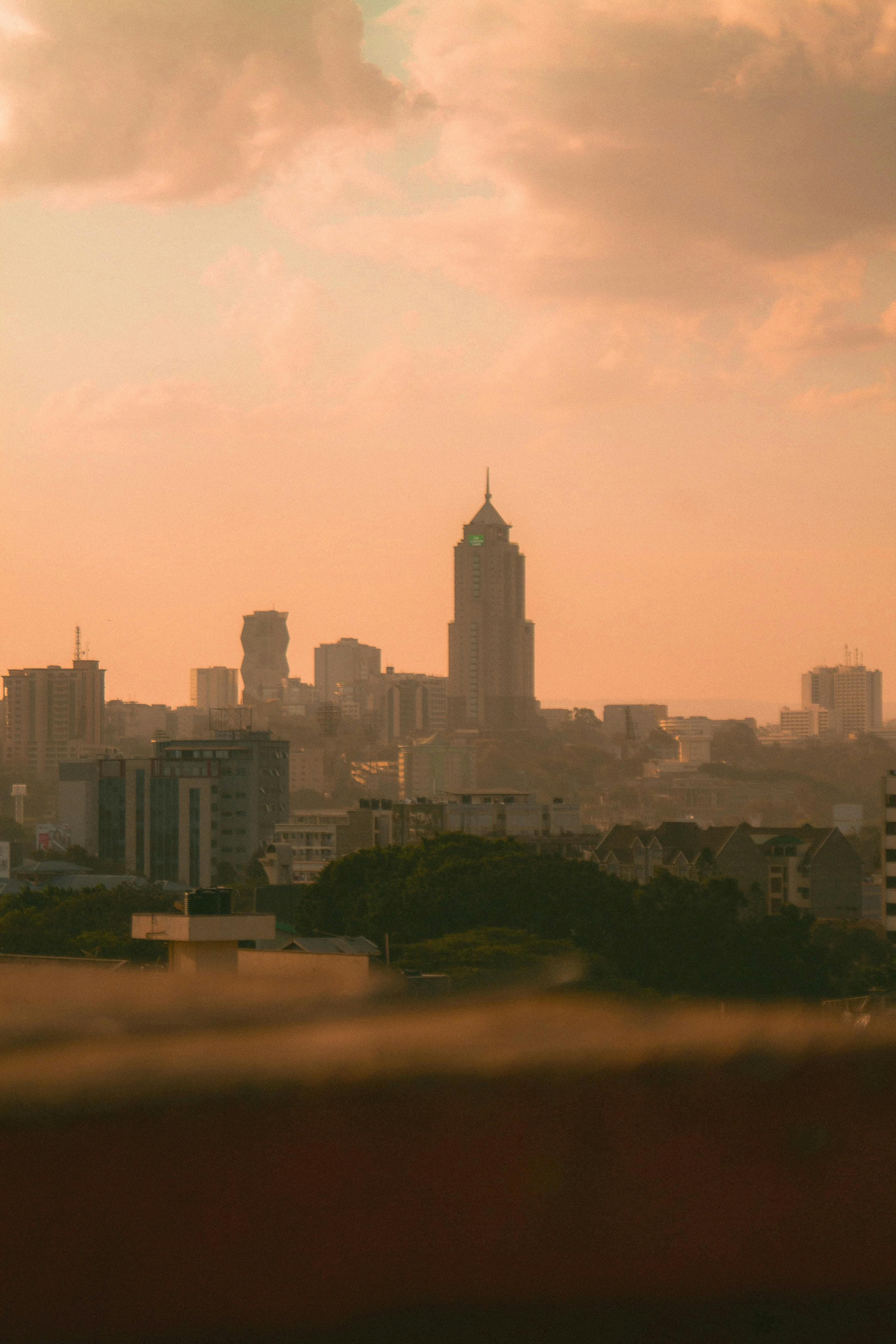
No promises in Nairobi by Polycarp Sakwa

The Editors
Contributor
Published in Qwani 04
-
Coins hit my bowl like raindrops on a basin - small, sharp sounds that say everything and nothing at once. Beside me I have a bottle of water to keep me hydrated when the sun becomes hotter later in the day. Tom Mboya Street is awake. Matatus cough black smoke into the air and honk like they’re competing to be the loudest in this so-called green city. Hawkers shout prices no one believes. “Karibia customer kuona ndio bure. Kuchagua ndio pesa". And somewhere in all that noise, I sit cross-legged on the pavement, waiting for Nairobians to notice me.
And they rarely do.
I’ve been on this spot near the statue of the late Kenyan icon Tom Mboya for two years now. The pavement knows my shape the way a bed remembers the body that sleeps on it. I know the rhythm of the street like an amapiano song whose lyrics play hide-and-seek game in mind.
Sometimes people act like they don’t see me, their eyes darting just past my head as if they’re short-sighted on purpose. Other times they stare too long, as if I’m the reason their lives are hard nowadays. And then there are the few who think I’m lucky- free from monthly rent, strict bosses and the weight of bills. They don’t know that freedom and hunger are cousins.
Across from me, a boy pretends to limp, dragging one foot as he tugs at jackets. People passing by give him more than they give me. Fake pain pays better than real hunger.
Nairobi city has its rules. I learned them the hard way.
Morning brings office workers moving in quick steps, eyes straight ahead, who drop a coin occasionally without breaking stride. Lunch time belongs to the office girls with their takeaway containers, some generous enough to share, others who cross the street so the aroma of their food doesn't mock my empty stomach. And evenings? That’s when the street belongs to real beggars, the ones whose faces tell stories no one wants to hear.
A matatu screeches to a stop near my corner. A woman jumps off, holding her son’s hand. The boy stares at me like he’s staring at his own future. His mother yanks him forward and says, “Brayo, ukiangalia sana, utakuwa kama yeye.”
I give a fake smile at that, though it cuts like a blade pressed slow against the throat. I was once that boy with clean socks, big dreams,and a mother who believed the world owed us something.
Now Nairobi owes me nothing.
I lift the bowl a little higher as a university girl passes. She avoids my eyes, digs in her bag, and drops a coin without looking. It lands with a soft chime. I whisper a thank you. She smiles as she disappears into a mammoth crowd.
Some days I use the coins to eat. Other days I buy airtime- just to call Safaricom customer care and hear someone say hello on the other end. Proof that I still exist.
The smell of hot mandazi drifts across the street, warm and heavy. My stomach tightens. Mandazi always does that—its smell takes me back to my first unforgettable morning in this green city. Before I learned that my first job in Nairobi would be begging. Before I learned that I would be wearing these shabby, torn clothes that nearly made other beggars kick me out not believing I deserved to be like them. Before I learned that Jogoo road does not have many jogoos that crow at dawn as opposed to rumors that had spread in my entire Kingandole village.
Back when I was in Kingandole village, I thought Nairobi was a place where you arrived, found your friend, and started a life. I thought promises meant something. I thought my first shoes would stay on my feet.
The mandazi smell gets stronger. The memory pulls harder.
I close my eyes, and I’m there again: a folded box under my back, shoes still on, a phone number clutched in my fist like a key to the city.
I didn’t know yet that keys don’t open anything here.
********************************************
The old woman with the gap-toothed smile, the one who'd welcomed me to Nairobi like she was offering condolences, was gone when I woke up. So was the folded box that had been my bed and the boy who offered it. And so were my shoes, and backpack with the two hundred shillings I'd hidden in the inner pocket, thinking I was clever.
Everyone who'd been sleeping around me had vanished like smoke.I sat barefoot on the Muthurwa concrete, cold climbing through my bones and settling in my chest, and wondered: how does someone steal shoes off your feet without waking you?
Across the road, matatus were already filling up. People moved like water - boarding, alighting,and rushing toward jobs I couldn’t imagine. Nairobi was stretching, yawning, and getting ready to ignore me for another day.
That’s when Kimbo appeared.
He came the way important people do in your life—suddenly, like he’d been waiting for the right moment to step out of the shadows. One second the space beside me was empty; the next, there was this skinny guy about my age in a faded Manchester United jersey that had seen better decades, maybe even better teams. He carried a small black plastic bag like it was his entire empire.
“Boss, rada? Unakaa familiar…we ni msee wa huku?” His voice had that smooth Nairobi Sheng which sounds like it knows things you don’t.
In Kingandole, people could always tell when someone had just returned from Nairobi. It wasn’t just from the clothes or the swagger but it was the way they twisted their tongue around Sheng. A single phrase was enough to draw stares, whispers, and sometimes envy.
Word would spread quickly:“So-and-So’s son has come back from Nairobi, and he carries the city on his tongue.”
In Kingandole, Sheng meant you had tasted a different air, and now you stood out among those who never left.
I looked at my bare feet, then at him. Everything about me screamed “fresh from shags”: the way I kept scanning the street like I was waiting for someone to take my hand to Afya Centre. Baitha way, I'm still looking for the owner of Afya Center and inform him not to paint another color on this building. It will confuse many people when they first come to Nairobi from Kingandole village.
At that moment my hunger felt like shame.“Mimi natokako Kingandole,” I said, as if that explained anything.
He laughed—not the mean laugh kind, but the laugh of someone recognizing himself in your story. “Kingandole? Iyo mtaa iko wapi, boss?”
“Busia county,” I said.
“Ah, mtu wa ushago! Karibu Kanairo.” .Ushago often sounded like an insult, especially coming from a city person, but from him, the way he said it, it sounded less like an insult and more like an invitation.
I wanted to tell him everything: how I’d arrived just yesterday with Shimonjero’s useless phone number, how it went straight to “Mteja wa nambari hapatikani kwa sasa” the moment I stepped off the Eldoret Express bus, how the promises of “come to Nairobi I link you with work” had dissolved faster than the morning mist over River Nzoia. I knew absolutely no one in this concrete jungle that seemed designed to swallow people like me. But the perfect words stuck in my throat like dry ugali.
Kimbo sat beside me like we were old friends, meeting regularly at Mama Atoti Nyama Choma zone. It felt like finding a pocket of calm in the storm.
“Mimi najulikana kama Kimbo,” he said, tearing a Muguka green leaf from a brown bag he held - those green leaves that keep night shift workers awake and make impossible dreams feel possible, at least for a while. “Nimekuwa hii Jiji miaka saba, brathe. Najua kila bez.”
My eyes widened to hear he had been in Nairobi for seven years. Everything about him seemed to have a story. First the way his eyes scanned the street seemed to show that he had a google map at his finger tips. Kimbo was composed and claimed space without asking, which made me believe that those seven years had been a masterclass in survival.
I watched him tear off a piece and start chewing, his jaw working like he was processing more than just leaves. Like he was chewing over possibilities, strategies, and the day's potential. "Unataka nikugawie kidogo?" he offered, extending the packet.
I shook my head. “Asante sana. Mimi niko sawa tu.” Back home, breakfast meant ugali with strong tea, something that would stick to your ribs and see you through to lunch. My mother, Agneta,was probably preparing exactly that right now, still believing her son had found Shimonjero and a big job in the big city.
Kimbo smiled like he understood. “Sawa. But sikiza vizuri. Brathe, hii Kanairo ni ya wale wajanja ndio husurvive uku.Ni lazima ujitume pia,” he heeded caution, cunning and urgency.
“Unamanisha nini ukisemako khandi ati ya wale wajanja?” Little did I know that my questioning of what cunning meant wasn’t meant to be answered at that moment. In time, I would be the one holding the right answer.
“Skiza, Krisandusi,” he said. “Nothing is for free here, but nothing is impossible if you know how to move.”
He stood, dusted off his shorts, and offered me his hand. “Kuja, nikushow kitu.”
I followed him through the awakening city, my bare feet dodging broken glass and bottle caps. We stopped at a mandazi spot where the seller arranged her golden triangles like they were small treasures.
“Unacheki huyo mama mandazi? Huunda mandazi karibu mia ama zaidi kwa siku,” Kimbo said, watching with a chess player's precision. “Na kila siku anaunda extra ju kuna zingine zitaungua.”
The smell hit me like a punch. My last meal was the day before, just before I boarded the Eldoret Express bus to Nairobi. My mother, Agneta, had made ugali wa mihogo with fried chicken. Ingredients and spices used could win a Guinness World Record, though nobody outside our village would care. Funny thing is, I didn’t know that would be my last decent meal for a while, and soon even mandazi in this Nairobi city would look like fine dining.
“Those burnt ones?” he continued. “She throws them away around ten o’clock. Unless…”
“Unless what?”
“Unless someone helps her carry water, or pushes her cart, or just talks to her with respect—reminding her we’re all somebody’s children.”
I looked at the woman and thought of Clementina,my auntie back home- the way she guarded food like it carried a piece of their soul.
“That’s not begging. It's different Kimbo,” I said.
Kimbo’s grin widened. “Exactly Kris. This is Nairobi. And you give something small, you get something big. It’s not about handouts; it’s about learning what people need to give.”
A group of university students passed us, arguing about an overdue assignment. One of them, a girl with natural hair, caught Kimbo’s eye. He nodded at her like they were equals.
She hesitated, then doubled back. “Mambo, bro.”
“Poa tu, siz,” Kimbo said. “Just showing my new friend around this city.”
She glanced at my bare feet, then at my face, and pulled a packet of kangumu from her bag. “For later,” she said, placing it in my hands.
When she walked away, Kimbo chuckled. “You see? She is so cute. She needed to help more than you needed to ask. That’s the game.”
We shared the kangumu as the city roared fully awake around us. For the first time since stepping off the bus, I didn’t feel invisible. My stomach was also remembered.
Kimbo turned to me, his voice dropping into something almost serious. “One thing you need to understand, Krisandusi from now on, you’re learning. And the first lesson is this: in Nairobi, you’re never just surviving. You’re always becoming. The question is… becoming what exactly?”
**************************************************
The street teaches you how to vanish while still standing there.
Two years in, Tom Mboya Street feels like a book I’ve read a thousand times. I know where the matatus hiss to a stop, coughing out office workers with tired eyes who throw coins just to feel good about themselves. I know which campus kids might hand you a smokie, laughing like it’s a joke. I know which women clutch their handbags tighter like I’m the reason their lives feel shaky.
“Begging isn’t just about stretching out your hand and saying ‘please help me.’ Out here, you have to make sure every word, every gesture, every look is part of the act.”. Limp and you double your take. Borrow a crying baby and people trip over themselves to give you notes. But Kimbo’s slogan goes like this: “Don’t just chase pity, brathe. Make them think they know you.”
Kimbo made me learn begging the hard way. The first day, he tossed me clothes so filthy they smelled like wet dogs. I almost cried wearing them. He laughed. “Shame doesn’t feed you. Dirt sells.”
But out here, it’s not just you hustling. The street is crowded with ghosts.
Take Ochopolo, the blind man who isn’t blind. His milky eyes are fake, as rumour has it that he bought his eye contact in Gikomba. He leans on a stick all day, humming gospel tunes. When night comes, I’ve seen him walk straight, counting his money with fingers faster than mine.
Or Mama Wairimu, who parks herself outside with a baby strapped to her chest. That baby is the same size every month. Someone told me she swaps them out from a dealer in Majengo.
And then there’s the boy in the wheelchair. He calls himself Abdul Mwenyewe. From the look of things Abdul can’t be more than ten. His handler pushes him around like a trophy, never talks to him, just rattles the cup for coins. One evening I followed them. A black car pulled up near River Road. The handler lifted the boy like a sack of flour, dumped him in, and they drove off. That’s what is popularly known to many Nairobi and as mchezo wa tauni. These streets eat even the ones who can’t chew back.
Me? I learned quickly. All I had to do was to limp on Monday, clutch my belly on Tuesday, look half-dead by Friday. Pain sells if you package it right. Once, Kimbo wrapped me in bandages, smeared tomato sauce to look like blood, and dragged me through the street screaming, “Help my brother! Help him!” Someone tried to haul me to Kenyatta Hospital. We bailed before it got real, and later we stuffed ourselves with mutura till we almost puked.
But there are days the street decides you’ve eaten enough.
It started like any other day. I picked a good spot outside a chemist, my bowl in front of me, my limp well rehearsed. Around noon, the sun turned mean, burning the tarmac till it smelled like melting shoes.
Then it happened.
A woman in high heels dropped a twenty shilling coin in my bowl. As she walked away, her iphone slipped from her bag. I didn’t dare to move or touch it. But a boda guy saw it hit the ground, snatched it, and sped off. She spun around, eyes blazing, and saw me sitting there.
“You thief!” she screamed.
Heads turned.
Before I could talk, a man grabbed my collar and yanked me up so hard my neck hurt. Someone kicked my bowl, coins scattering like rats across the pavement. A crowd formed fast as Nairobi loves a show.
I kept shouting, “Si mimi! It wasn’t me!” but it didn’t matter. When you look like dirt, people believe you belong to it.
Slaps came first. Open palms, sharp and hot. Then kicks, wild and careless. My ribs felt like they were folding in. Someone spat in my face. Someone else called me “chokora” like it was my name.
Kimbo wasn’t there.
By the time a cop showed up, I was half-lying, half-sitting, bleeding from my lip. He didn’t ask what happened. Just told the crowd to “discipline us properly next time” and walked off chewing gum.
I crawled into an alley behind a hardware shop and sat there shaking. My hands were still trembling when Kimbo finally found me hours later, muguka stuffed in his cheek like nothing had happened. He laughed when he saw me.
“Brathe, today the street baptized you. Now you’re a real beggar."
I wanted to give him a knock punch like that of famous boxer Mike Tyson. Instead, I laughed too, because that’s what you do. On these streets, if you don’t laugh at pain, pain laughs at you.
But Kimbo was changing.
He chewed muguka like it was oxygen. Talked too much, sometimes to himself. Started calling what we did “business” like we were running a company. Then came his new crew. Red eyes, sticky hands, smelling like weed and trouble.
One night, as we crouched under a busted streetlight sipping uji power, he said, “This street is just a school, brathe. I’m not dying here. I’ll stack enough, move to Eastleigh, open a big shop. You’ll see me. I’ll be the guy supplying muguka as a wholesaler. People will kneel for my leaves.”
He sounded crazy. But hunger makes crazy sound holy.
I was learning my own craft of reading people like scriptures:
The guy sending half his salary to shags walks like each step is a receipt.
The househelp hauling her boss’s shopping walks like she’s balancing someone else’s future on her spine.
The student two semesters from graduating walks like hope might break if they blink too long.
Kimbo always said, “People don’t give ‘cause they feel sorry for you. They give ‘cause they wanna believe they’re still human.” And he was a genius at letting them believe it.
But Nairobi doesn’t like people who think they’re smarter than it.
One afternoon, I caught Kimbo’s crew huddled near the bus stage. Their bags were fatter than usual. Their whispers had teeth.
“Brathe, trust me,” Kimbo said when I asked. “This is the move. After this, we’re done with this life. We are going to start a new one. ”
I didn’t poke my fingers on his nose any longer. In this city, questions are like stones—you throw one and you don’t know what’s going to come back to your head.
That evening, as the sun bled over the skyline, Kimbo stood with me on my usual pavement. Coins dropped into the bowl slowly, like lazy raindrops. Across the street, a boy limped past, selling pain like it was art. Kimbo chewed his leaves, grinning like he’d already left Nairobi behind.
“Hatutakaa hivi milele, brathe,” he said. We won’t be like this forever.
I wanted to believe him. But the city? The city doesn’t promise forever. The city only promises change—and it never asks if you’re ready.
*******************************************
News travels fast here, but it never travels with flowers.
By the time I opened my eyes that morning, Kimbo’s name was already currency. Hawkers traded it with their customers, beggars passed it down the line, even the touts threw it in their chants like it was part of the fare:
“Fifty bob to Ngara na Kimbo amekufa!”
No one said it too soft. No one said it too sad. In Nairobi, people don’t mourn, they adjust fast, too occupied with other things.
I didn’t ask questions. Questions are expensive. All I knew was Kimbo wasn’t under the busted streetlight where he used to chew his muguka and dream about Eastleigh shops. No crumbs, no laughter, just an empty space that felt louder than the city’s noise.
They said it was a job gone wrong. A muguka deal. Maybe cops. Maybe thieves. But here, the details are decorations. You hang them on the story to make it look nice, but the wall underneath is always the same: Kanairo eats its own.
So I picked up my bowl and went to my usual spot on Tom Mboya. Because grief doesn’t pay.
But it sat in my chest like a stone. Coins dropped into the bowl, same as always, but they sounded different like metal hitting water, and echoing too long. Every face walking past looked like Kimbo for a split second. A matatu tout chewing leaves too fast. Even the crippled boy being wheeled past by his handler—I half expected him to grin and say, “Brathe, hatutakaa hivi milele.”
That afternoon, I walked to Makaburini. It was where Kimbo’s burial had taken place.
It’s strange, how Nairobi’s noise thins as you head there, like the city itself is pretending not to notice its own graveyard. The air smelled of dust and boiled cabbage from a nearby kibanda. A drunk man yelled about politics to no one in particular. Otherwise, it was quiet.
Kimbo’s grave was fresh. There was no marker, just a wooden cross with his name written wrong: KIMBWA. Even in death, this city doesn’t bother to get you right.
I stood there longer than I meant to, bowl hanging limp at my side. What do you even say to a guy who taught you how to fake limps and charm biscuits off strangers? I thought of his voice that last evening: “After this move, we’re done with this life.” Maybe he believed it. Maybe he didn’t. Doesn’t matter now.
“Brathe,” I muttered, “you said this street is a school. So, maybe you graduated with a Masters.”
A wind kicked up, throwing grit into my teeth. The city’s way of laughing, maybe.
I was still standing there when someone said my name. My real name, the one I hadn’t heard in two years.
“Krisandusi?”
I froze at that moment. It wasn’t the voice I expected. The voice was all too familiar, carrying the proper Luhya pronunciation of my name.
A man stood by the gate of Makaburini, hands in his pockets like he owned the ground. It took me a second to notice him. It was my primary school friend, Franco from Kingandole. Franco had a big belly back then. It was the first thing I noticed. He has good clothes on and that belly says life had been feeding him well.
He stared at me, then at my bowl, then back at me.
“So it’s true,” he said, voice flat. “Two years in Nairobi, and this is what you’ve been doing?”
My throat went dry. I wanted to say something clever, something streetwise. Instead I said nothing.
Franco walked closer, shaking his head like he was trying to scatter the picture of me sitting on Tom Mboya with a limp and dirty clothes. “You told everyone you were working in an office,” he said. “You even sent your mother that first M-PESA message after receiving your salary.”
He then went on to tell me what my mother had done thereafter.
The day her phone lit up with that message—“Confirmed. You have received Ksh 1,000”—my mother, Agneta, hurried to the green-painted kiosk, her hands trembling as she keyed in her PIN. The market women paused their gossip. Even the boda riders leaned on their bikes to watch. She lifted the notes high, smiling with pride—like proof that her son’s Nairobi dream was real.
By sundown, the whole village was saying it: Krisandusi had made it.
But she never knew I sent it only so she could keep believing.
I gripped the bowl tighter. “I was going to…”
“To what? Make it real later?” He barked a laugh, but it wasn’t funny. “You think you’re the only one with dreams? We all dream, Kris. We just don’t lie to our mothers while chewing on garbage.”
The words cut, but not deeper than I’d already been cut by this city. I thought of Kimbo, buried under soil spelled wrong. I thought of the woman in high heels calling me a thief. I thought of the boy in the wheelchair, driven off like cargo.
Franco sighed. “Come back home,” he said finally. “Kingandole is poor, but at least it won’t kill you.”
He turned to leave, but stopped halfway. “Or stay here,” he added, not looking at me. “Keep begging until the street graduates you too.”
I stood there long after he left, staring at Kimbo’s grave.
I chewed on the choice in front of me: go back to Kingandole and face the shame, or stay here and wait my turn under a misspelled cross.
Coins clinked in my bowl as the wind shifted. Someone had dropped them in without me noticing.
I didn’t know whether to laugh or cry.
-
Photo by Suheil Mohammed
Join the Conversation
(0 comments)Sign in to join the conversation
Share your thoughts and engage with our community