Escaping Manyani by Kimemia Macharia

The Editors
Contributor
Published in Qwani 02
-
I could not feel my legs anymore. I’d been tied up upside-down from my ankles for what felt like an hour. The four walls of this torture chamber would not let a single ray of sunshine through. The little light in the room got in through small circular apertures in the iron sheets above. The four walls weren’t plain. They were embellished by little adornments that revealed the horrors that took place within. A blood splatter here, some whips hanging from nails over there, electric cables spilling out of a socket near me, a tooth that lay miserably by itself in the corner there… Don’t get me started on the smell. My hands were bound as well, and I held them in front of me against my chest.
I tried to turn my head pensively to take in my surroundings, and when I did, my eyes met the cold, blue eyeballs of the mzungu who was my interrogator. Though I saw him in an inverted fashion, I could still make out the malicious mien on his face. His white skin gleamed with sweat in the tropical heat and appeared pinkish. The sweat then trickled down to the collar of his beige uniform. “He wouldn’t have to suffer this heat if he had just stayed home in England,” I thought to myself. Next to him was an African soldier who played the role of the interpreter, although his futility in my interrogation was soon going to present itself. His skin was as dark as mine. Actually, it was darker. He belonged to a special regiment in the British Army that was made up entirely of African soldiers: the Kings African Rifles (KAR). Stealing our land was not enough, they even enlisted us to go fight in their wars. It was just the three of us inside this torture chamber.
“Are you ready to talk?” The deep guttural voice of the mzungu penetrated the silence, slicing it like a hot knife through a block of butter.
The KAR soldier promptly translated his statement to Kikuyu, the tongue of my mother and father. I stared blankly at the two upside down figures in front of me, then said nothing. The mzungu gestured at the translator who grabbed a whip from the wall and unleashed several lashes on my bare back. With each lash, the whip tore into my skin, sending spasms of pain through my body. When he stopped I could feel beads of blood dripping down my back onto the floor. I gritted my teeth in agony.
“Did you swear the MauMau oath?” the mzungu proceeded to ask.
I interrupted the translator mid-sentence, looked the mzungu straight in the eye and replied in fluent English, “I have done no such thing.”
I watched as his expression slowly changed. I was not sure if he was impressed by the fluency I had picked up along the corridors of the missionary school I attended in my younger years, or infuriated by the words that I chose to form with it. My uncertainty was soon put to rest as he exploded in a fit of rage and snatched the whip from the translator. He descended on me, inflicting countless lashes, not just on my back, but on my chest as well as my arms and my face. He huffed loudly as he inflicted lash after lash on my skin. The bellows he let out reminded me of the beasts we would encounter in the forest in the days before my capture as we battled the colonial troops.
In all the six weeks of my detention thus far, I had been a recipient of the tortures of this room several times. Major Harry Day, the mzungu, was burdened with the task of inspiring confessions from detained forest fighters, he tried unsuccessfully to elicit one from me. You see, I had already been sentenced. Two months before this, my lawyer had watched helplessly as I, Kinyua son of Mbaria, was found guilty of being in possession of arms and consorting with individuals considered dangerous by the government. That warranted the death sentence. What leniency would you expect from a colonial court in 1954, midway through a nationwide emergency? Major Harry, however, presented an opportunity for clemency. All I had to do was admit to having sworn the MauMau oath and commit to the process of ‘rehabilitation’ in the weeks that followed. Having used up all the grace period that I was entitled to, my date with the executioner was fast approaching, and this would be the last time Major Day and I would find ourselves cooped up within the four walls of this torture chamber.
He crouched such that our heads were level with each other and explained the severity of my situation as though I was not already aware of the noose that loomed in my near future.
“All you have to do is confess to swearing the oath then denounce it and your life will be spared,” He implored in a calm voice.
I mustered all the strength I had left in my frail body and whispered, “I did not swear to any oath”.
Major Day stood up in defeat. He glanced at the KAR soldier who had been a silent onlooker to the events that were transpiring and instructed him to take me back to the detention halls.
“He hangs tomorrow,” those were the last words I would hear from Major Day, at least that’s what I thought.
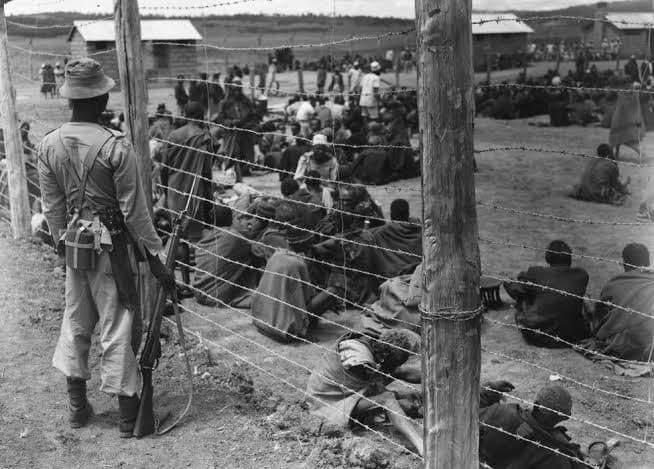
The KAR officer unbound my legs and I fell with a thud to the ground beneath me. Despite my back seething in pain from the lashes, I enjoyed receiving sensation in my legs again as blood flowed back into them. The officer ushered me to my feet and clad me back in my dusty shirt. He opened the door in front of me and a blinding surge of light accosted my face, causing me to squint my eyes. When they eventually adjusted I was led down onto the path that led to the detention halls. The structures of the Manyani Detention Camp that had been my home for the past few weeks revealed themselves.
To my right, I could see the gate guarded by both British and African officers gently caressing various firearms. I was slowly making peace with the impending reality that I, would never set foot outside this place again. We continued walking, and I let my eyes gaze at the mud pit where we were daily subjected to the back-breaking work of baking bricks under the unbearable heat of the sun. I could see some of my fellow detainees working there while being overseen by frowning colonial officers. I was almost glad my appointment with Major Day had exempted me from providing labor there today. My bliss was short-lived as the sun penetrated my shirt and hit the freshly-inflicted scars on my back. I could feel the blood causing my shirt to stick to the wounds and I winced in pain. I let my eyes wander into the even broader horizon over the tight mesh of barbed wire. Dry flatlands stretched on for as far as the eye could see. Is this where I would die? In a barren land miles away from the lush, fertile landscapes of my ancestral home in Nyeri?
As if to confirm my hypothesis we passed by the gallows where many of my brothers had breathed their last. Executions in Manyani happened at 11 pm on every alternating night. The bodies from last night’s exercise swayed slowly in the midday breeze still attached to the ropes that had squeezed the life out of them. Flies encircled them trying to sap any moisture from their festering openings. Rather than bury them immediately, the soldiers at the camp let the lifeless bodies remain there after execution to serve as a warning to all those who refused to denounce the Maumau oath. My neck would soon hang similarly from one of those ropes. A fitting sacrifice to the struggle of the liberation of our land.
We eventually reached the detention halls which stood parallel to each other numbered 1 to 7. I belonged to Hall 3 and was promptly ushered in with the door locked behind me. I passed several familiar faces that glanced at me piteously, and found my way to my friend Wanuma, son of Mwaura. We had been together in the forest fighting for our land, and had been arrested and arraigned together. Then on the morrow, as fate would have it, we would die together, hopefully side by side, with a fistful of soil in both our hands as was the custom. Brigadier Nyamanduru (which was Wanuma’s name in the forest), however, had other plans.
I lay on the ground next to him and moaned in pain as my wounds felt worse with every movement I made. He was also nursing wounds of his own as he had paid Major Day a courtesy call just before my appointment.
“Did you tell him anything?” He asked me as soon as I was comfortable.
The Kikuyu he spoke was a welcome relief from the foreign tongue I had been exchanging with that white man. I shook my head in negation and his lips parted to a proud smile. Through it, I realized a new gap in his jaw where a tooth would have been. We had both stuck to the terms of the oath we swore and that gave him all the satisfaction in the world.
“Now we can wait patiently for the hangman’s noose to take us to a higher world where we may rejoin our brothers and ancestors,” I murmured.
“Kinyua, what if there was an alternative? Why are you killing us in your mind yet our lungs are full of air?” His rhetorical questions were filled with optimism but I had neither the patience nor the hope to indulge him.
“I’ve perfected the plan. We can leave tonight!”
This statement made me sit up. The plan he was speaking of was an escape plot that he had been brewing in his mind from the moment our feet landed on the arid soils of Manyani. Every single time he brought it up, I had highlighted the impossibility of any such plan working considering the place was teeming with armed, trigger-happy officers who would love an excuse to put a bullet in a detainee’s back. Even if we made it outside the camp, we still had no idea how to get home. Nyamanduru was a KAR veteran who had fought for the British in both World Wars and had turned down a promotion to Sergeant seeking immediate discharge. In the forest, we had leveraged on his reconnaissance and organizational skills in the brutal war we were waging against the White Man and his forces. Here, he had put those same skills to use as he meticulously observed the goings on of the camp. His most prized possession was a wrist watch which he had acquired in his deployment in Burma. Miraculously (or perhaps due to his previous military service to the British Crown), he had been allowed to keep it even after his trial and incarceration. In places such as this, a wristwatch might mean the difference between life and death.
“Fine then. Tell me what you have in mind,” I enquired as I leaned in attentively.
He whispered his plan to me, slowly musing over each detail. It is in moments like these that Nyamanduru’s military expertise really shone. I listened as he narrated to me every single aspect of the colonial officers’ nighttime routine. Each event was precise to the second. In my mind I wondered how he had acquired all this information, but by this time, his genius no longer perplexed me. It had saved my life countless times in the forest and it seemed like it was about to do so yet again. He then explained how we would take advantage of their routine to sneak our way out of the camp through a cavity he had observed in the barbed wire on the Southern side of the fence. When he had finished explaining, I realized that this was a crazy plan. A crazy plan that might just work.
If we stayed here, we were certainly going to die the following day. If we tried to escape, there was a high likelihood that we would be shot down by the hordes of officers guarding the camp. But there was a slight, slim chance that we could actually escape and make it out of the camp.
After weighing my alternatives, I smiled at him and said, “I’m in.”
Our conversation was interrupted by the wail of an air horn. In the camp this signaled that it was time for our daily meal. The sound was ever so dear to our ears. At that point, hunger pangs, mortal injury and a ravenous thirst were all competing to end my misery long before the noose got a chance to. As we lined up for the meal, one of the detainees who worked in the kitchens walked over to us and whispered a few things to Nyamanduru’s ear then left. When he was gone, Nyamanduru informed me that he would be accompanying us tonight in our escape plan as he knew his way around the nearby town and would come in clutch as we found our way home. His name was Kabiti. I had recognized him from my time in the forest but had never spoken to him. I wished we could take more people with us, but for a plan as volatile as ours, it would be better to risk only a few lives.
The ugali and beans we had subsisted on monotonously every day since we arrived at the camp had never had as savory a flavor as it did on that day. Maybe that’s because it was meant to be one of my last meals. After the meal, we made our way back to the halls while being escorted by armed guards. Nyamanduru and I lay on the ground hardly speaking in order to preserve our energy as we waited for nightfall.
In the silence and stillness of the hall, I drifted off to sleep and when my eyes opened I was surrounded by greenery. The pain in my body was not there anymore. I recognized this view. Rolling hills punctuated with farmlands and slow streams burrowing their way through the valleys. This is the view from my homestead in Nyeri. When I turned to look behind, my wife stood there. The last time I saw her, she was heavy with a child, but now, she stood in front of me with a flat tummy and a peaceful countenance on her face. Her beautiful face.
“You swore an oath Kinyua,” she reminded me in a sweet still voice.
How much I had longed to hear her voice again. She was right, I had sworn an oath. I would do anything to repel the white invaders and get our forefathers’ land back. She pointed southwards and when I looked I saw the tall white capped mountain that rose majestically from the foothills in the distance. The god of my people lived at the apex of this mountain.
“Come back to me Kinyua. Come back to us. Your people need you.”
Just as she said this, a violent shake on my arm drew me from my dream and back into the crowded detention hall. It was Nyamanduru waking me up with Kabiti standing next to him. The moonlight poured in through the window and shone on his face. It was time.
The hall had two separate entrances, one on each side. The main one was locked from the outside, but the rarely-used one was locked from inside. We tiptoed to it silently, being careful not to awaken any of our fellow detainees. Nyamanduru drew a pin from his wristwatch and carefully picked the padlock until it snapped open. Kabiti had a glimmer of disbelief in his eyes as we walked out of the door and bolted it silently behind us. We crouched behind Hall 3 and Nyamanduru looked at his watch. I had a peep too and saw that it was exactly 3 am. Time for the change of guard. In the moonlight, I could see the armed shadowy figures of the officers who were meant to curtail any chance of escape. As Nyamanduru had predicted however, they all signaled to each other and began to walk in the direction opposite to us towards the main garrison from where they would be relieved.
When the coast was clear, Nyamanduru led us on, and we paced soundlessly towards the mud pit. If any of the guards were to make the mistake of looking behind, they would have seen the three of us illuminated in the silver moonlight. None of them, however, did. We made it to the mud pit where the next phase of our operation was to actualize. The southern side of the camp had high watchtowers, complete with searchlights which brightly lit up the compound in that direction. These were all factors we had taken into consideration. The guard change in the watchtowers would not take place for another 30 minutes so we waded into the mud pit and submerged ourselves to our neck to wait it out.
Like most arid areas, Manyani was bitterly cold at night. I was not properly sensitized to this fact as the congested detention halls ensured we huddled together and were insulated despite not having adequate bedding. Here in the mud pit, the cold was rawer than ever, causing my muscles to quake and shiver. By this time, fresh guards had taken up their posts around the detention halls. We were stuck in between them and the watchtowers of the Southern side. We just had to wait. Anxiety, as a result of the inactivity, caused my nerves to be restless and my heart pounded in my chest with no regard for rhythmic consonance. My body was still sore from the previous day’s tortures but the mud felt like a soothing embalmment to the wounds.
Time sluggishly dragged on. Every minute felt like it lasted a lifetime. I marshalled every iota of patience I had. We could hear the guards conversing in the distance as they vigilantly patrolled the area. When we were about twenty minutes into our vigil, the unexpected happened. From behind us, a rather enthusiastic guard was gradually making his way towards the mud pit. The three of us glanced at each other in terror. Nyamanduru signalled the two of us to submerge ourselves completely. He would handle the situation.
The guard edged dangerously close to the pit then stopped. He walked along the perimeter while his eyes scanned away from the pit. Just as he got close to us, Nyamanduru hurled himself out of the mud with athletic agility and landed on his feet right behind the guard. He held the guard in a sleeper hold and fell to the ground with him using his legs to immobilize the guard completely. The abruptness of the attack must have made the guard forget the Sten gun that was slung across his torso as he writhed in suffocation with Nyamanduru’s hold growing tighter and tighter against his neck. His organs eventually gave in and he lay still against Nyamanduru. To my surprise, all this had occurred without detection from any of the guards around us. He pushed the motionless body of the guard into the murky pit and got in after him.
I relieved the guard of the weapon and when Nyamanduru wiped the mud off his timepiece and glanced at it, the time was nigh for the guard change. It was our chance to make our move. We slithered silently out of the pit and started crawling towards the southern fence under the cover of the tall unkempt grass. As we crawled, the perpendicular magazine of the gun dug into my ribs but it was nothing I could not persevere. We held our position just as we saw armed guards climbing down from each of the three watchtowers. The searchlights shone down on us immaculately and we dared not move a muscle until the guards were clear for fear of being detected. As they strode further and further away, an immense feeling of hope replaced the anxiety, for behind the watchtowers, I could see the cavity through which we would make our final escape.
When the coast was clear, we sneaked in a semi-crouched manner and veered to the left. We were trying to avoid being in the glare of the searchlights so we hid behind a toilet shack that the guards would use. From here, we would compose ourselves before making one ultimate dash to freedom. Nyamanduru, Kabiti and I pat each other on the back with premature excitement and readied ourselves for the sprint of our lives.
Just as we were about to set out, the door of the toilet opened from inside and a half-asleep uniformed man strode out. I could not believe it. It was Major Day! This toilet was the nearest one to his quarters and he had woken up to relieve himself. We stared at each other for a brief moment as his conscience tried to piece together what was going on.
“What are you doing here?” he sneered in revulsion.
He opened his mouth again to yell for help, I assumed, but before he could do that, I instinctively squeezed the trigger of the Sten gun I was holding. Three rounds were spat out of the barrel and into Major Day’s chest. He fell, first to his knees, then facedown to the ground. As my eyes shifted up to Nyamanduru, he approached me and tore the gun from my grip.
“The gunshots must have been heard from all around the camp. Guards will be upon us any second now,” he was merely stating the obvious.
“You and Kabiti need to run. I’ll cover you”.
We all knew what this meant. Nyamanduru was about to sacrifice himself for our sake. I tried to mount a protest but he squeezed something into my hand, folded my fingers around it then shouted, “Go!”
Without a second thought, Kabiti and I ran towards the cavity in the fence. We hurried past the watchtowers and were soon trying to widen it enough to allow ourselves through. Before the fast approaching guards had gotten a chance to spot us, Nyamanduru had acquired a defensible position and opened fire drawing all the attention to himself. This worked very effectively as a fierce gunfight ensued. Although he knew he was going to die, Nyamanduru sold his distinguished life dearly, taking as many guards down with him as he could. Moreover, he bought us enough time to make it out of the camp and created the illusion that he was the only one trying to escape.
Even after we were outside, we kept running. We didn’t know where we were headed. We kept running until we could not hear the gunfire anymore. We eventually stopped under a towering baobab tree to catch our breath. It is at this point that I studied the trinket that Nyamanduru had placed in my hand. It was his precious wristwatch. Tears welled in my eyes but I fought them back. This was no place to cry. My closest friend had just sacrificed himself to secure my freedom. It was my duty to ensure his sacrifice would not be in vain.
As dawn approached the horizon, I turned to Kabiti who seemed as charged up as I was. With an ardent resilience in my voice I asked him, “Where do we go from here?”
To communicate more with the writer, find him on:
Email: kimemiamusic@gmail.com
Join the Conversation
(0 comments)Sign in to join the conversation
Share your thoughts and engage with our community